


Ho Chi Minh City's New Financial Center: The Primary Engine for Grade A Office Space
The majority of upcoming Grade A office supply is concentrated within the new financial district, demonstrating strong prospects to attract international banks, technology firms, and global capability centers. In early
The majority of upcoming Grade A office supply is concentrated within the new financial district, demonstrating strong prospects to attract international banks, technology firms, and global capability centers.
In early July, UOB Vietnam broke ground on its new corporate headquarters situated on a parcel exceeding 4,570 m² in the Ba Son area. Representing a total capital investment of USD 450 million, the 36-story tower falls within the defined perimeter of the Vietnam International Financial Center in Ho Chi Minh City (VIFC-HCMC).
Mr. Wee Ee Cheong, Deputy Chairman and Chief Executive Officer of UOB Group, noted that the new headquarters reflects the institution's confidence in Vietnam’s growth trajectory and aligns with Ho Chi Minh City’s strategic objective to establish itself as an international financial hub.
According to projections by CBRE, total office supply in Ho Chi Minh City will expand from 1.7 million m² this year to 2.0 million m² of floor space by 2030. Between 2026 and 2028, approximately 76% of all new Grade A office space will be situated directly within the boundaries of VIFC-HCMC.
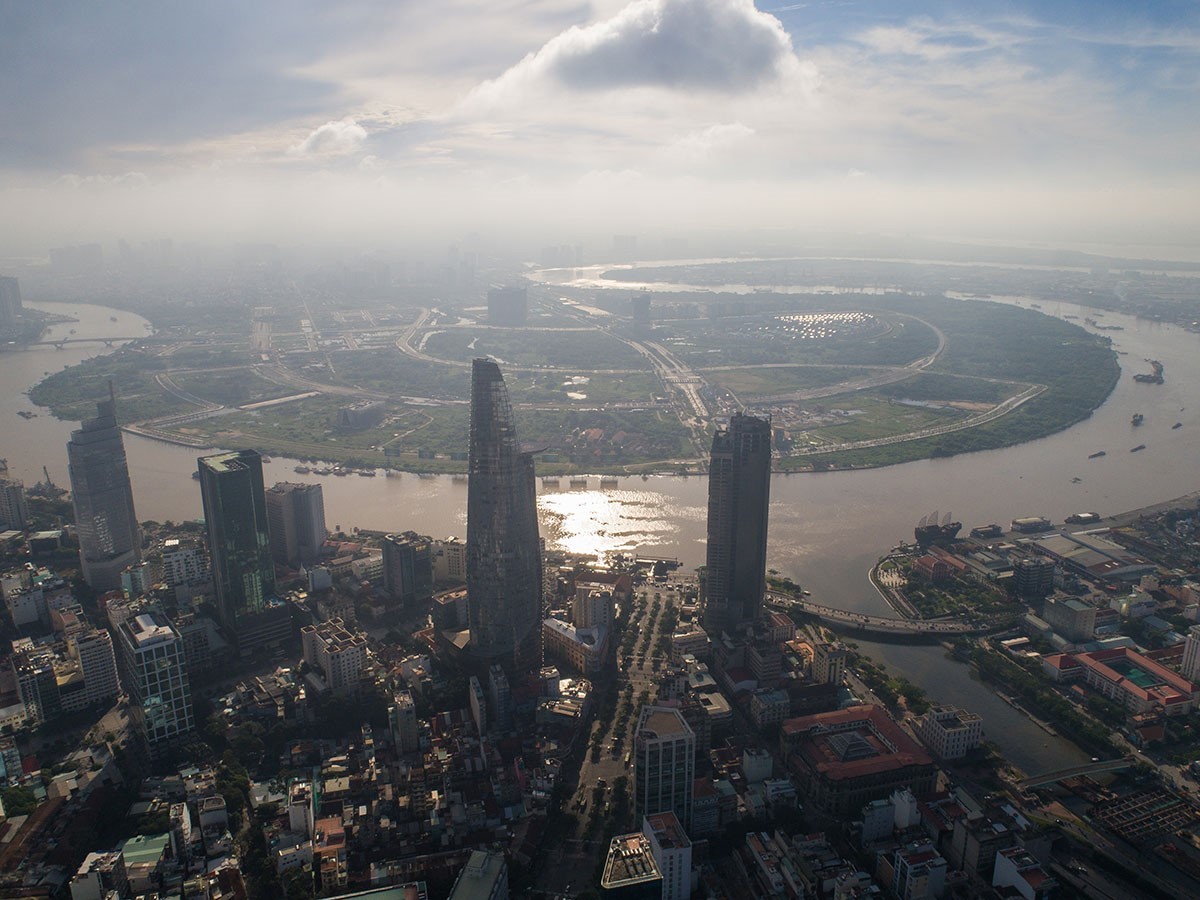
Officially operational since February 11, VIFC-HCMC spans an 898-hectare master-planned zone comprising Sai Gon Ward, Ben Thanh Ward, and the Thu Thiem New Urban Area (An Khanh Ward).
Speaking at the Investment Promotion Conference for the Vietnam International Financial Center on the morning of August 11, Assoc. Prof. Dr. Nguyen Huu Huan, Vice Chairman of the VIFC-HCMC Executive Agency, stated that the financial center will feature modern, international-standard infrastructure. The master plan incorporates Grade A office complexes, 11 towers, and an iconic 99-story landmark skyscraper.
"This landmark development in Thu Thiem is designed to serve as a visual anchor aimed at attracting strategic anchor investors and world-class project developers," Assoc. Prof. Dr. Huan stated.
Mr. Le Trong Hieu, Senior Director of Office Leasing Advisory at CBRE Vietnam, observed that VIFC-HCMC possesses the potential to serve as a primary growth catalyst, elevating Ho Chi Minh City’s status within the regional commercial real estate landscape.
"Over the next 5 to 10 years, we anticipate that VIFC-HCMC will facilitate the influx of institutional financial entities, multinational corporations, and high-quality capital flows, thereby driving sustained demand for Grade A office assets that meet international benchmarks," Mr. Hieu remarked.
Demand within the Grade A office sector remains robust. Data from Avison Young indicates that during Q2, prime Grade A assets in central Ho Chi Minh City continued to draw strong tenant interest from technology enterprises, financial institutions, professional services firms, and foreign direct investment (FDI) entities.
Across the first half of the year, average rental rates for the Grade A segment ranged between USD 47 and USD 50 per m² per month, with an average vacancy rate of approximately 16.7%. Mr. Hieu noted that while the vacancy rate appears elevated, Grade A buildings accounted for over 90% of total net absorption (approximately 47,000 m²) over the past year.
"This indicates that when corporate occupiers relocate, their decision-making is heavily weighted toward building quality, strategic location, and expansion capacity, rather than rental rates alone," he analyzed.
Industry experts note that prospective corporate occupiers at VIFC-HCMC extend beyond traditional commercial banks to encompass financial technology (fintech) firms, aviation finance institutions, maritime finance entities, and green finance organizations.
Furthermore, the tenant pool includes information technology enterprises and Global Capability Centers (GCCs). A GCC is a dedicated organizational unit handling information technology (IT), research and development (R&D), data analytics, and innovation functions for multinational corporations.
A prominent GCC currently established within VIFC-HCMC is the NAB Innovation Centre Vietnam, operated by National Australia Bank, which employs approximately 3,000 software engineers. Assoc. Prof. Dr. Nguyen Huu Huan shared that VIFC-HCMC aims to attract approximately 50 GCCs over the next decade. "If each GCC employs roughly 3,000 professionals, the financial district will need to supply office infrastructure capable of accommodating approximately 150,000 personnel," he noted.
Mr. Le Trong Hieu added that Grade A office space at VIFC-HCMC holds a competitive cost advantage, with operational and personnel costs standing at merely 20% to 30% of those in Singapore or Hong Kong. However, experts emphasize that attracting top-tier global institutions requires a sustainable ecosystem spanning physical infrastructure, institutional framework, and legal clarity.
Regarding physical infrastructure, environmental sustainability certifications (green building standards) have become a standard site selection requirement for international corporate occupiers since 2019. Institutional experience from Singapore demonstrates that major financial corporations mandate smart building systems, wellness-oriented work environments, large floor plates exceeding 1,600 m², and seamless mass rapid transit (metro) connectivity.
In addition, an attractive investment climate at VIFC-HCMC serves as an indirect growth driver for the commercial office market. After six months of operational deployment, total committed capital from domestic and international partners reached approximately USD 20 billion.
Mr. Jonas Ringstad, Asset Management Director at REE Corporation, noted that investor confidence is built not only upon the progressive regulatory frameworks established by VIFC-HCMC, but crucially upon tangible execution.
"Institutional investors need to observe concrete operational milestones, such as the licensing of the first international bank, the execution of initial transactions, and the legal precedent set by arbitration mechanisms handling dispute resolutions for the first time," Mr. Ringstad cited as examples. Furthermore, experts recommend that VIFC cultivate a sophisticated market populated by diverse entities engaged in complex financial activities to attract global talent and domain experts.
Article's source from Vnexpress